How to Start AI Freelancing in 2026: A Beginner's Guide to Earning Online
How to Start AI Freelancing in 2026: A Beginner's Guide to Earning Online
Quick honesty up front: I am a developer, not a full-time freelancer running an agency. But I use the exact AI tools this whole market is built on every single day, I have taken on freelance dev work, and I have watched a lot of people around me try to start earning online — some well, most badly. So this is a grounded guide, not a "quit your job and make $10k a month" pitch.
The good news is that AI freelancing is genuinely accessible. You do not need a CS degree or big upfront money. You need an existing skill — writing, design, video, research — plus real fluency with AI tools and a laptop. What separates the people who earn from the people who quit is almost never talent. It is consistency and delivering work that does not look like a raw chatbot dump.
What AI freelancing actually means
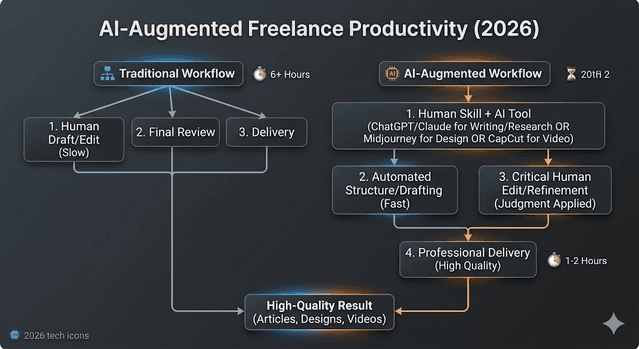
Let me kill the biggest misconception first: it does not mean AI does the work while you collect the money. Clients absolutely can tell the difference between edited, refined output and raw generation pasted into a doc. Raw AI work gets rejected, refunded, and leaves you with bad reviews.
What it really means is using AI to do your existing work three to five times faster without dropping quality. A writer using ChatGPT for drafts and research handles far more projects. A video editor using CapCut's AI compresses a six-hour edit into one. The thing you are selling is the outcome — the article that ranks, the design that converts — not the fact that AI was involved. AI is the production tool, not the product. That distinction is the whole game.
Which services actually pay in 2026
Not every AI service is equal — some are saturated and race-to-the-bottom, others have real demand and few capable providers:
AI content writing and SEO blogging — steady money, roughly $300–$1,500/month per client for regular content. The differentiator is editing; raw AI copy does not rank or match a brand voice.
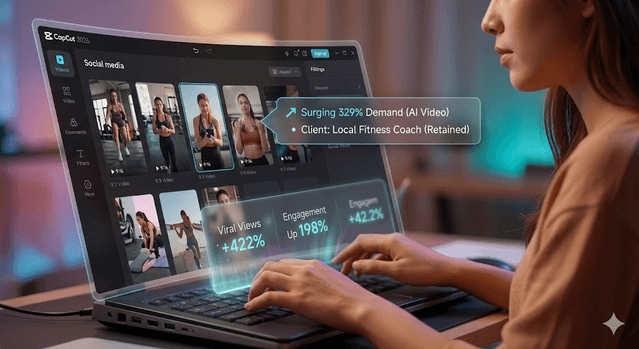
AI video editing and short-form — the fastest-growing category, around $50–$150 per video. Coaches, local businesses, and e-commerce brands need constant video and lack the time to make it.
AI chatbot building — customer-service bots on platforms like Botpress or Voiceflow, $300–$1,500 per project. Lots of small businesses want one and have no idea how to build it. As a developer, this is the niche I would personally lean into.
AI virtual assistance — email, scheduling, research, content ops using AI, $500–$2,000/month on retainer.
AI image generation and design — assets, social graphics, mockups with Midjourney or Firefly, $30–$150 per asset, more for brand packages.
AI consulting — helping small businesses pick and set up tools, $75–$200/hour and one of the highest-margin options if you know the landscape.
Where to find your first clients
Three platforms dominate:
Upwork — the biggest pool of higher-budget work. Name the AI tools you use directly in your profile (ChatGPT, Midjourney, CapCut) and the tasks you use them for. Show samples that prove output quality.
Fiverr — you publish "gigs" and buyers find you. Best for defined, repeatable services: "5 SEO blog posts with professional editing," "10 branded social graphics."
LinkedIn — underused by beginners, but it produces the best long-term clients. Post examples, connect with business owners in your niche, engage with founders talking about content or marketing problems. Slower, but higher quality.
Pick one, build reviews there, then expand. Splitting effort across all three at once is how beginners stall.
A practical starting plan
The fastest path from zero to first paid work:
Pick one service. Not five. Layer AI onto the skill you already have.
Make three portfolio samples before you apply — they do not have to be paid. A writer: three posts in different niches. An editor: three short clips.
Set your rate 20–30% below your target at first. Your first goal is not maximum income, it is your first five-star reviews. Reviews compound faster than pricing does — three of them beat a higher rate with none.
Over-deliver early. New clients have no reason to trust you yet, so remove uncertainty with clear communication and delivery ahead of deadline. That is what earns the reviews that unlock better work.
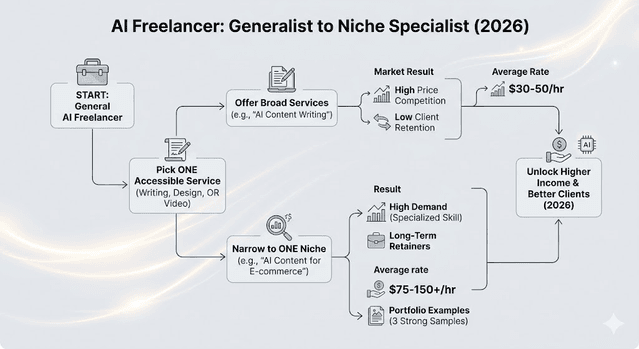
After three to five projects, raise your rate and niche down. Generalists compete on price; specialists (the chatbot builder for law firms, the editor for fitness coaches) charge more and attract better clients.
Realistic income timelines
I would rather be honest than hype you. Most people who work at this consistently reach $500–$1,500/month in the first three months. Hitting $3,000/month usually takes about six months of steady client acquisition. Full-time replacement ($4,000–$8,000/month) is realistic in 12–18 months if you treat it like a business, not a hobby you touch occasionally. The people who get there are the consistent ones, not the most talented ones.
Tools worth actually learning
You do not need all of them — master the two or three that support your service:
- ChatGPT / Claude — writing, research, editing, drafting. Essential for content, useful everywhere.
- Canva (AI features) — design and social content without a design degree.
- CapCut / Runway — video; CapCut for fast social, Runway for premium control.
- ElevenLabs — realistic AI voiceover.
- Midjourney / Adobe Firefly — image generation.
- Botpress / Voiceflow — chatbot building.
Depth beats breadth. Two tools you truly know pay more than ten you dabble in.
Mistakes to avoid
Shipping unedited AI output. The bad reviews come from delivering raw generation, not from using AI. Every deliverable needs your judgment on top.
Pasting confidential client info into public AI tools. This is a real legal and contractual issue in legal, medical, and finance work. Check privacy settings and be transparent about your tools if asked. As a developer I take this seriously — treat client data like production credentials.
Billing hourly when your efficiency should reward you. If AI turns a four-hour post into 90 minutes, hourly billing punishes your speed. Charge for the deliverable and its outcome.
Adopting too many tools. Scattered knowledge of ten tools pays less than genuine skill with two.
Letting your portfolio go stale. It is the first thing clients judge you on. Keep your strongest recent work up front.
The long-term picture
AI freelancing is not passive income or a shortcut. It rewards the same things all skilled work does: reliable delivery, clear communication, consistent quality, and understanding what the client actually wants. What AI changes is the economics of production — work that used to need expensive tools or many hours is now faster and cheaper, which lowers the entry barrier and raises how much one person can output.
The people who will still be earning well in three to five years are the ones with genuine depth in one or two tools, applied to a specific niche, with a reputation for better outcomes delivered faster. Start before you feel ready — everyone earning now started from the same uncertain place. The clients and income follow from work delivered, not from preparation alone.
Get Weekly AI + Tech Updates
Receive practical AI tools, workflows, and hand-picked resources in one concise weekly email.
Software Developer & Founder
MCA graduate and Flutter developer (web, Android & iOS), writing from hands-on experience with AI and productivity tools.
I'm Mohd Washid, a 23-year-old software developer. I hold a BCA (2022) and an MCA (2024), and I build cross-platform apps with Flutter for web, Android, and iOS. I started AI Tech Minty to share the AI and productivity tools I actually use in my day-to-day development work — cutting through the hype with practical, hands-on guidance you can act on the same day.