Best Tech Skills to Learn in 2026 for Remote Work and High Income
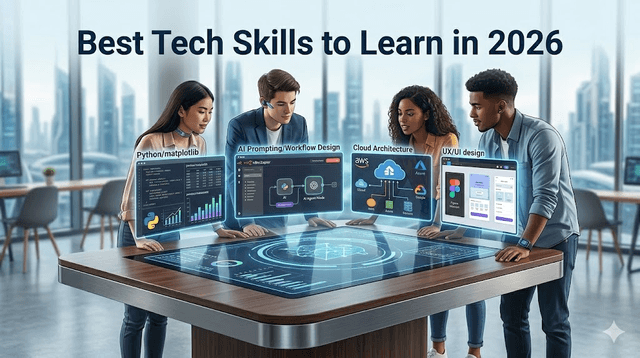
Best Tech Skills to Learn in 2026 for Remote Work and High Income
I work as a developer, and the honest reality is that the skills that got people hired five years ago are not the same ones that matter now. AI has quietly automated a lot of routine technical work. So the skills worth your time today are the ones that need human judgment, or that make you faster with AI rather than replaceable by it.
If you are trying to figure out where to spend your learning hours, this is how I would rank things — with realistic timelines, because I have been through the learning curve myself and the "learn X in 30 days" promises are mostly lies.
Quick skill comparison
| Skill Area | Time to Basic Competency | Remote Potential | Entry Earning Range |
|---|---|---|---|
| AI prompting and workflow design | 3-6 months | High | $50k-$70k |
| Python programming | 6-9 months | Very high | $60k-$90k |
| Data analysis and visualization | 4-8 months | High | $55k-$80k |
| Cloud computing | 3-5 months | Very high | $65k-$95k |
| Cybersecurity | 6-12 months | Moderate-high | $60k-$85k |
| UX/UI design | 4-8 months | Very high | $55k-$80k |
Why this choice matters so much
Learning the wrong skill is expensive — not in money, but in time you cannot get back. I have seen people grind for a year on something the market was already automating away. The goal is not to predict the future perfectly. It is to pick skills with durable demand and real human-AI collaboration built in. The ones below pass that test.
1. AI prompting and workflow design
Every company adopting AI needs people who can configure, prompt, and wire those tools into real workflows — and it does not require an engineering background. Start with solid prompt skills, learn automation with n8n or Zapier, then go deep in one industry. It is one of the most accessible high-demand skills right now.
Time: 3–6 months · Remote: High · Entry: $50k–$70k
2. Python programming
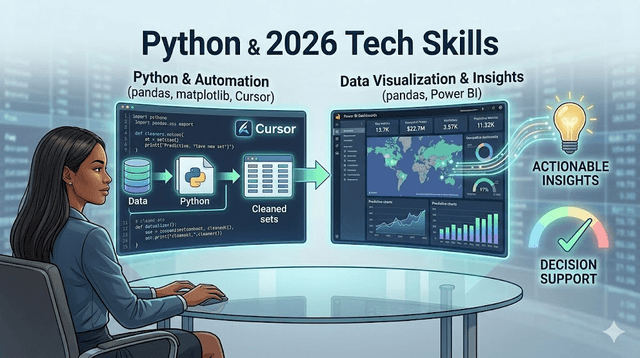
This is the one I would push hardest for most people. Python powers data work, ML, automation, and backends — and it is the language AI assistants write best, so a Python dev using Cursor or Claude produces far more than one working alone. You do not need to be a senior engineer; being able to write automation scripts, analyze data, and build simple APIs already opens real doors. It is also a genuinely enjoyable first language, which matters for sticking with it.
Time: 6–9 months · Remote: Very high · Entry: $60k–$90k
3. Data analysis and visualization
Companies drown in data and still cannot turn it into decisions. Analysts who clean, process, and visualize clearly are in steady demand. Core stack: Python (pandas, matplotlib) or SQL/Excel for smaller work, plus Tableau or Power BI. AI sped up the processing, which means the human value shifted to interpreting and communicating — exactly where judgment still wins.
Time: 4–8 months · Remote: High · Entry: $55k–$80k
4. Cloud computing (AWS, Azure, or GCP)
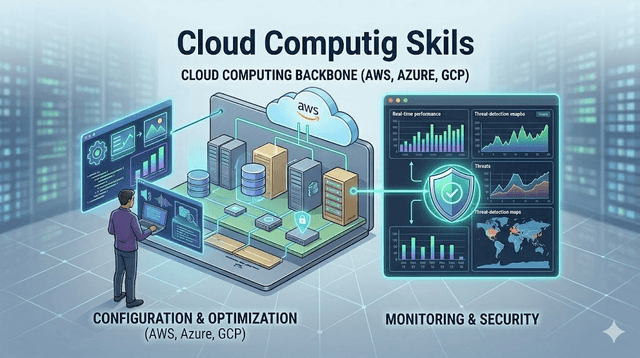
Cloud is the backbone under basically every product I have worked on. Entry certs (AWS Cloud Practitioner, Azure Fundamentals, Google Associate Cloud Engineer) are doable in a few months and genuinely move the hiring needle. The path from practitioner to DevOps or cloud architect has strong income growth, and most of these roles are remote by default.
Time: 3–5 months with cert · Remote: Very high · Entry: $65k–$95k
5. Cybersecurity
As AI scales up the speed of attacks, security skills only get more valuable. Roles like security analyst and incident responder have consistent demand, and CompTIA Security+ is a solid starting credential. It is also one of the few fields where hard-won judgment resists automation, so experienced people face less disruption.
Time: 6–12 months · Remote: Moderate–high · Entry: $60k–$85k
6. UX and UI design
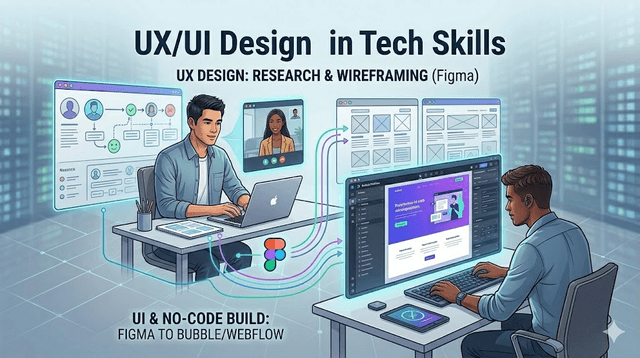
Good design is in demand and genuinely hard for AI to nail at a professional level. UX designers who understand users, do research, and turn insight into clean interfaces stay essential. Figma is the standard and fully learnable from free material. A portfolio of three to five documented case studies matters more than any certificate for landing early work.
Time: 4–8 months · Remote: Very high · Entry: $55k–$80k
7. No-code and low-code development
Webflow, Bubble, Retool, and Zapier let non-programmers build real tools and automations. Plenty of startups hire no-code builders to ship internal systems faster and cheaper than full dev cycles. It is a great on-ramp for career changers who do not want a multi-year programming climb — and pairing no-code with AI integrations makes you especially hireable.
Time: 2–4 months · Remote: High · Entry: $45k–$70k
8. Technical writing and AI content strategy
Documentation, guides, and API references pay well and are very remote-friendly. AI made first drafts faster, but structuring, verifying, and clearly communicating complex technical information is still human work. As someone who reads a lot of docs, I can tell you clear technical writing is rarer than it should be — which is exactly why it is valuable.
Time: 3–6 months · Remote: Very high · Entry: $50k–$75k
How to choose
The right skill sits where three things overlap: real market demand, overlap with what you already have or enjoy, and a realistic timeline for your situation. Writing background? Technical writing. Numbers person? Python or data. Visual thinker? UX. Do not chase the highest salary headline regardless of fit — motivation and consistency beat theoretical earning potential every time in the early months. That is the mistake I see sink the most learners.
A six-month framework
A realistic plan from scratch: month one, pick your target role and skill. Months two to three, work through foundational material. Month four, build a small real project. Month five, refine it and start showing up in communities (GitHub, LinkedIn, Discord) in your area. Month six, apply and take on small freelance work to build credibility. Learning is far faster when tied to a real project — abstract exercises get boring fast, and boredom is what kills consistency.
Final thoughts
The most durable 2026 skills are the ones that work alongside AI, not against it. Python devs who use Cursor and Claude ship more. Analysts who let AI handle processing spend more time on insight. UX designers use AI to ideate but still make the calls. Pick one skill, commit for six months, build something real, and put it in front of people who will give you honest feedback. Repeat that loop — it is how tech careers actually get built, whatever the specific tech.
Common path-planning mistakes
- Choosing a skill based only on salary headlines
- Skipping portfolio projects until "after learning"
- Consuming tutorials without building real outputs
- Switching target skills every few weeks
Get Weekly AI + Tech Updates
Receive practical AI tools, workflows, and hand-picked resources in one concise weekly email.
Software Developer & Founder
MCA graduate and Flutter developer (web, Android & iOS), writing from hands-on experience with AI and productivity tools.
I'm Mohd Washid, a 23-year-old software developer. I hold a BCA (2022) and an MCA (2024), and I build cross-platform apps with Flutter for web, Android, and iOS. I started AI Tech Minty to share the AI and productivity tools I actually use in my day-to-day development work — cutting through the hype with practical, hands-on guidance you can act on the same day.