Deep Work in 2026: How to Focus in an Age of AI and Constant Distraction
Deep Work in 2026: How to Focus in an Age of AI and Constant Distraction
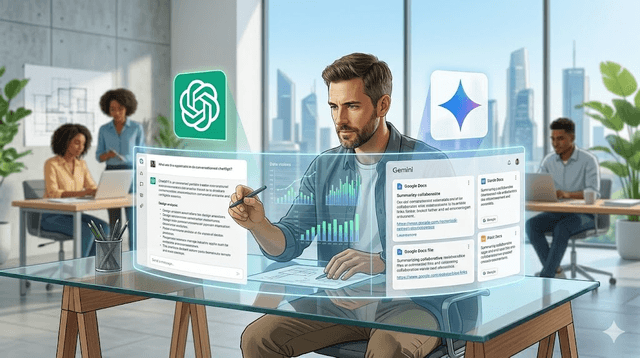
Here is a paradox I feel in my own work every week. The tools that make me faster also make it harder to focus. An AI assistant can compress four hours of coding into ninety minutes — but it pulls me into constant back-and-forth: checking responses, refining prompts, validating output. Add notifications and tab-switching, and I sometimes end a "productive" day feeling like I never actually thought deeply about anything.
I am not alone in that. Plenty of people with more powerful tools than any generation before them report feeling less focused. Deep work — sustained concentration on genuinely hard tasks — is getting rarer and more valuable at the same time. This is what actually helps me, adjusted for the reality of AI tools and remote work.
Quick strategy comparison
| Strategy | Setup Effort | Typical Impact | Common Failure Point |
|---|---|---|---|
| 90-minute protected sessions | Medium | High | Scheduling conflicts and weak boundaries |
| Notification audits | Low | Medium-high | Re-enabling non-essential alerts |
| Bounded AI usage phases | Medium | High | Sliding back into continuous chat mode |
| Device separation during deep work | Low | High | Keeping phone within reach |
| Blocking apps/websites | Medium | Medium-high | Turning blockers off during stress |
Why focus is harder in 2026 specifically
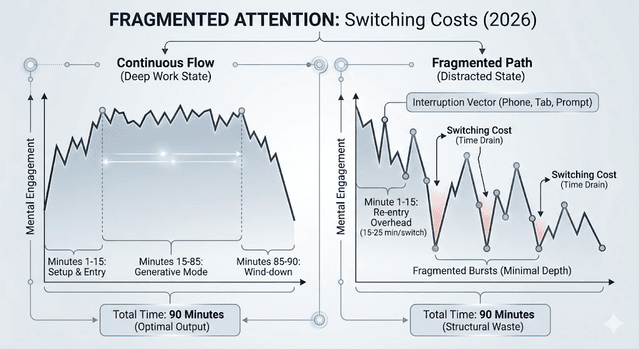
Distraction is not new, but its shape changed. Old productivity advice assumed the enemy was procrastination. For me the real enemy now is fragmented attention — working in short bursts between notifications, tool prompts, and messages.
Every interruption costs more than its length. Coming back to a complex problem after even a brief break can take 15 to 25 minutes to reach the depth you had before. As a developer I feel this acutely: getting a whole mental model of a bug back in my head after an interruption is expensive. When interruptions land every few minutes, deep engagement is structurally impossible no matter how disciplined I am.
AI added a new twist. Because assistants respond instantly and need active steering, they pull me toward reactive mode — checking, refining — instead of the generative mode that produces original thinking. A session that starts as real problem-solving can drift into a back-and-forth that yields decent output but never develops my own understanding.
The core principle: protect uninterrupted blocks
Every serious approach to focus lands on the same structural fact: meaningful cognitive work needs blocks long enough to reach depth. For most hard tasks the minimum is about 90 minutes. Below that, the time spent loading the problem into your head plus the little time left before the next interruption keeps you out of the zone where the best work happens.
Most of us do not have regular 90-minute uninterrupted blocks — our days are chopped into 30-minute slivers by meetings and self-interruption. Reclaiming just one or two protected blocks a day, consistently, produces a wildly disproportionate improvement. The real question is not whether deep work is valuable. It is what you are willing to protect to make room for it.
The 90-minute session structure
A structured session beats an unstructured one of the same length, because structure cuts the decision overhead of starting.
Minutes 1–10: Setup. Define the specific deliverable — not "work on the project" but "solve the bug in the auth flow" or "draft section one." Write it down. Close everything non-essential. Phone on Do Not Disturb or in another room. Start your focus audio if you use it.
Minutes 10–85: Focused work. One deliverable. When your mind jumps to something else or you feel the pull to check messages, write the distraction on a list and go straight back. The note frees the mental space without letting you actually leave.
Minutes 85–90: Wind-down. Note where you are, what is next, and any loose threads — so re-entry next session does not start from scratch.
Then take a real break, 15–20 minutes. Walking or light movement recovers focus far better than scrolling.
Scheduling around remote-work reality
Remote work gives more schedule control than an office does, and most people waste it by treating "remote" as "always available." What works for me is putting deep work in my highest-energy hours — the first two to four hours of the day — and pushing meetings, email, and reactive work to the afternoon when sustained concentration is harder anyway.
A realistic week: two 90-minute morning blocks (say 8–11am with a 20-minute break), meetings and communication 1–4pm, admin and next-day prep in the final hour. If back-to-back morning meetings shred your mornings, have the direct conversation about blocking two or three mornings a week for focused work. Most reasonable managers say yes when actually asked.
AI tools: which help focus and which hurt
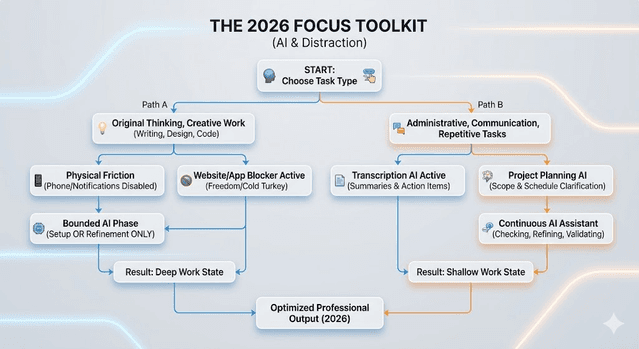
Helps focus:
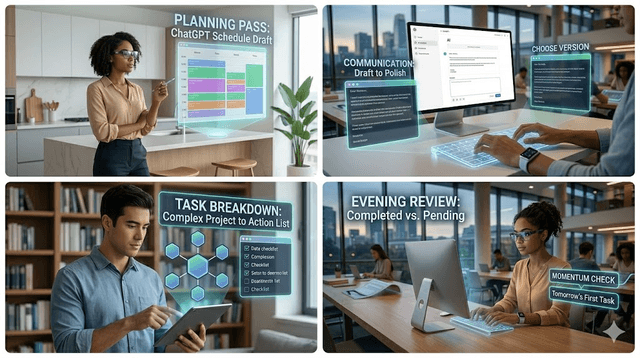
Planning AI that clarifies the deliverable before a session starts. Beginning a block with a clear, specific target removes the decision overhead that drains the first few minutes.
Transcription/note-taking AI that processes recordings after meetings, so I can actually engage during the meeting instead of splitting attention taking notes.
Hurts focus:
Continuous AI chat during the session. The instant-response pull competes with deep engagement. For genuinely original work — writing, analysis, hard debugging — I do better with a stretch of no AI, then bring it in to refine.
Notification-enabled AI integrations. Every tool that pings you is another interruption vector. Audit them and kill anything not truly time-sensitive.
The pattern I follow: get AI input to define the task, do the core generative work in silence, then use AI to review and extend afterward.
Managing digital distraction
Notification audits. Weekly, I review which apps pinged me. Anything that did not need immediate action gets disabled. Most people can silence 80–90% of apps with zero impact on responsiveness.
Async communication norms. Teams that expect near-instant replies structurally prevent deep work. A shared norm like "non-urgent messages get a reply within four hours" is one of the highest-leverage focus changes available.
Physical device management. The phone is my biggest interruption source. Putting it in another room beats any app or setting — physical distance is stronger friction than a toggle.
Website/app blocking. Tools like Freedom or Cold Turkey remove the option instead of relying on willpower. For most of us, willpower alone is not enough, and that is fine.
The role of physical environment
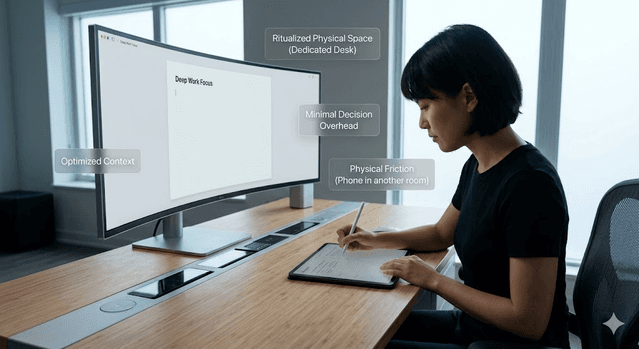
Where you work matters more than people think. If you mostly work from a couch or bed, your brain has tied those spots to relaxation, which fights focus. A dedicated desk and a consistent startup ritual (same chair position, same brightness, clean surface) create conditions that make it easier to drop into deep work. It is not perfectionism — it is reducing the friction of starting.
Temperature, light, and sound are personal. Cooler rooms (around 20–21°C) suit sustained focus for most people, natural light beats artificial for alertness, and some focus in silence while others need brown noise or lyric-free music. Test your own settings rather than following a prescription.
Is it working?
The goal is not to follow a routine — it is better work, more consistently. I track two things weekly: hours of genuinely focused work (real 90-minute, interruption-free sessions), and my honest satisfaction with the thinking during them. If hours rise but satisfaction does not, the work may not be complex enough to need deep focus. If satisfaction is high but hours are low, the bottleneck is protecting time, not technique.
Who this helps most
This suits developers, knowledge workers, students, and builders whose output depends on sustained thinking. It applies less to constant real-time-response roles, where shorter protected blocks plus tight team norms are more realistic.
The compounding return
The payoff compounds in a way I did not expect. Early on, the benefit is just finishing more meaningful work per day. Over months, something bigger happens: you get measurably better at the things you practice with full attention. Complex skills — coding, writing, analysis, design — improve through deliberate practice in states of high concentration. People who regularly do focused work in their domain improve faster than those logging the same hours with split attention.
In a world where AI handles more routine work and human value shifts toward judgment and hard problem-solving, the ability to focus deeply is a genuine career asset. Start with one 90-minute block a day for two weeks, treat it as a non-negotiable appointment, and measure what you produce in it versus everything else. Your own data will tell you whether to expand.
Get Weekly AI + Tech Updates
Receive practical AI tools, workflows, and hand-picked resources in one concise weekly email.
Software Developer & Founder
MCA graduate and Flutter developer (web, Android & iOS), writing from hands-on experience with AI and productivity tools.
I'm Mohd Washid, a 23-year-old software developer. I hold a BCA (2022) and an MCA (2024), and I build cross-platform apps with Flutter for web, Android, and iOS. I started AI Tech Minty to share the AI and productivity tools I actually use in my day-to-day development work — cutting through the hype with practical, hands-on guidance you can act on the same day.