How AI Is Transforming Healthcare in 2026: Diagnosis, Docs, and Drug Discovery
How AI Is Transforming Healthcare in 2026: Diagnosis, Docs, and Drug Discovery
The promise of AI in medicine has been repeated so many times over the past decade that many people have grown skeptical of the headlines. Researchers announced breakthroughs. Startups raised enormous rounds. And meanwhile, most hospitals continued running on the same overstretched workflows, the same documentation burden, and the same diagnostic processes.
2026 is different, not because AI has suddenly become magic, but because deployment has quietly matured. The big headlines are fewer. The real changes are embedded in clinical workflows, insurance systems, drug pipelines, and the daily experience of both patients and physicians.
Two things up front, in the interest of honesty. I am a software developer, not a clinician — so I write about this from the technology side, and nothing here is medical advice. And because it is healthcare, I have leaned hard on named, verifiable sources rather than my own opinion. What I can offer is a clear read on where the AI is genuinely working versus where the hype outruns reality. Here is where it is actually making a measurable difference today — and where important cautions still apply.
Quick use-case comparison
| Area | Current Practical Value | Main Risk | Human Oversight Needed |
|---|---|---|---|
| Clinical documentation | High: reduces administrative burden | Inaccurate note capture | Clinician review before finalization |
| Diagnostic imaging support | High in pattern-recognition-heavy workflows | False positives or misses | Specialist interpretation remains required |
| Drug discovery acceleration | Medium-high: faster candidate prioritization | Early-stage overconfidence | Research and trial validation gates |
| Early warning monitoring | Medium-high in acute settings | Alert fatigue and model drift | Clinical triage and escalation protocols |
The documentation crisis and AI's most practical early win
Healthcare workers currently spend up to 70 percent of their time on administrative tasks. That statistic has been cited for years without meaningful change. In 2026, AI-powered electronic health record integration is beginning to move the needle.
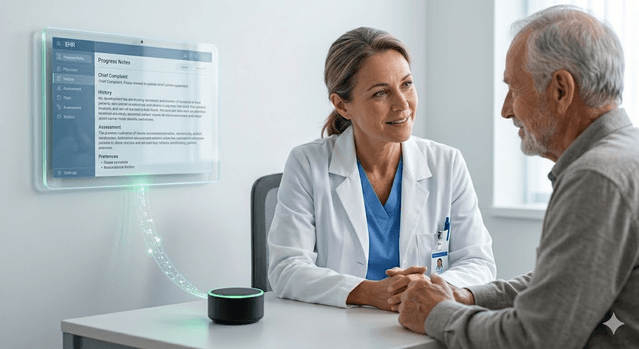
AI systems now draft clinical progress notes automatically by listening to patient-provider interactions and structuring content into standard medical documentation formats. These are not rough outlines requiring heavy editing. In active deployments, clinicians report that AI-generated notes require minimal revision and are increasingly being accepted by major insurance providers for billing purposes.
The projected impact is significant. Analysts estimate that AI-powered EHR integration could reduce the administrative burden by approximately 50 percent for routine documentation tasks, potentially saving the average physician 15 to 20 hours per week. That time can be redirected to patient care, consultation, or simply to working sustainable hours rather than burning out.
This is perhaps the least dramatic-sounding application of AI in medicine, but it may be producing the most consistent real-world benefit in 2026 precisely because it targets the most concrete, measurable problem: physician time.
Diagnostic imaging: AI as a second reader
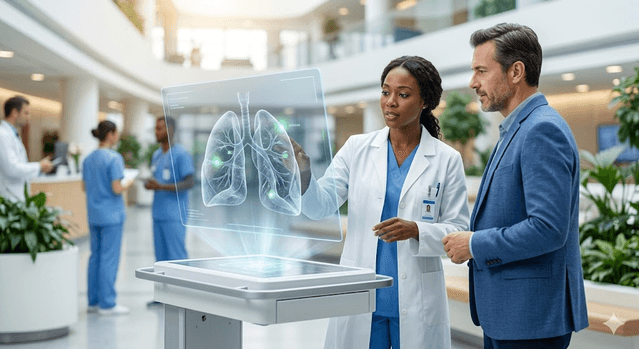
The clearest transformation in clinical care is happening in diagnostics, particularly imaging. AI systems are increasingly used as a "second reader" in radiology, dermatology, and pathology — scanning images before or alongside human specialists and flagging anomalies for attention.
According to the National Institutes of Health, AI systems have demonstrated higher sensitivity in detecting certain diseases, including lung cancer and diabetic retinopathy, with improvements in early detection outcomes in imaging-heavy clinical settings. Systematic reviews support that AI tools improve detection performance specifically where pattern recognition on large image datasets is the core task.
The key word is "alongside." The most effective deployments treat AI as a quality-check layer, not a replacement for specialist judgment. A radiologist who reviews AI-flagged images still brings clinical context, patient history, and judgment about ambiguous findings that models do not yet replicate reliably.
What has changed from five years ago is that AI now operates in production clinical environments, not just research papers. Hospitals are making actual patient care decisions using AI-assisted imaging tools, and regulatory frameworks are evolving to accommodate this shift.
Drug discovery: from years to months
Digital health startups raised $4 billion in venture capital funding in the first quarter of 2026 alone — a $1 billion increase over the same period in 2025 and the strongest opening quarter since the pandemic peak. A significant portion of that investment is flowing into AI-driven drug discovery.
The AI biotech sector is moving past foundational models toward what researchers call the "clinical era." Multiple AI-designed drug candidates are expected to reach critical clinical milestones throughout 2026. The industry has largely shifted from talking about molecules and models to actually moving computational predictions into human trials.
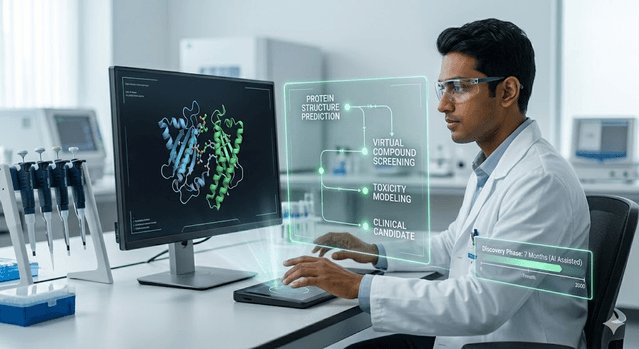
The traditional drug discovery process — from target identification to clinical candidate — can take five to ten years and cost hundreds of millions of dollars. AI-assisted discovery is compressing timelines dramatically in specific areas. Protein structure prediction, virtual screening of compound libraries, and toxicity modeling have all been transformed by machine learning systems that can evaluate millions of candidates in the time it would take human chemists to analyze dozens.
This does not mean AI is inventing drugs autonomously. It means AI is identifying the most promising candidates faster, reducing the experimental burden on human researchers, and flagging potential failure modes earlier in the process when they are cheaper to catch.
Predictive analytics and early warning systems
Beyond diagnosis and drug discovery, AI is being integrated into hospital monitoring systems to predict patient deterioration before clinical signs become obvious.
Early warning systems use machine learning models trained on thousands of patient records to detect patterns in vital signs, lab results, and medication responses that correlate with deterioration events — sepsis, respiratory failure, cardiac events — hours before they manifest overtly.
The results in active hospital deployments are measurable. Patients flagged by AI early warning systems receive faster intervention. Intervention outcomes are better when response is earlier. These systems do not replace clinical judgment, but they extend the effective attention of clinical teams who cannot monitor every patient simultaneously.
The limitations and risks that still matter
The progress is real, but so are the risks — and being honest about them is important.
AI hallucination in clinical settings remains a serious concern. Unlike a chatbot generating a confident but wrong answer about a historical date, a clinical AI that produces a confident but wrong diagnostic suggestion can affect patient care. Research from the University of Colorado found that adding demographic data such as ethnicity or sex to identical patient presentations can flip an AI model's predicted diagnosis, raising important questions about embedded bias in clinical AI.
Over-reliance on model outputs is an emerging behavioral risk. Studies suggest that human diagnostic performance can shift depending on whether AI support is present — in some cases, clinicians become less attentive to subtle clinical signs when they trust an AI system to catch them. When the AI misses something the clinician would have caught independently, the error compounds.
Regulatory frameworks are still catching up. California's law effective January 2026 requires chatbots to disclose their AI nature and bans those without suicide-prevention protocols. Multiple states have introduced bills mandating human review of AI-assisted insurance denials. These are early signals of a regulatory environment that is actively adjusting to the reality of AI in clinical care.
Data bias reflects the populations used to train models. Most clinical AI has been trained predominantly on data from well-resourced health systems in developed countries. Performance can degrade significantly when applied to populations not well-represented in training data.
What patients should understand
AI in healthcare in 2026 is mostly invisible to patients. You are unlikely to be told explicitly which diagnostic tools or workflow systems involved AI. Most of the applications are in back-end infrastructure: documentation, image analysis, early warning systems, and scheduling optimization.
If you want to understand how AI might be affecting your care, the most useful questions to ask your care team are: whether AI-assisted imaging tools are used in reviewing your scans, whether documentation is automated, and whether any clinical decision support tools inform their recommendations.
As a patient, the practical implication is that AI is generally adding a layer of pattern recognition that catches things humans might miss — but human oversight remains central to all clinical decisions. The goal is not to remove clinicians from the loop. It is to make clinicians more effective within it.
Who should use this information carefully
This guide is educational and operational in scope. It is useful for understanding where AI is helping healthcare systems and where caution is still necessary. It is not medical advice and should not replace individualized diagnosis or treatment decisions from licensed clinicians.
The bigger picture
Healthcare is adopting AI at twice the rate of the broader economy, according to a Forbes analysis citing Menlo Ventures data. Only about 20 percent of organizations are currently using it at scale, meaning the majority of the transformation is still ahead.
The measure of success in 2026 is not whether AI works in controlled trials. It is whether it can be governed, audited, and trusted in real clinical environments with real patients. The organizations making the most meaningful progress are those investing as much in governance and explainability as they are in model performance.
AI in medicine is not replacing the human elements of healthcare. It is absorbing the parts of healthcare that should never have required human time in the first place — so that the humans who went into medicine can spend more of their hours doing what no algorithm can replicate.
Get Weekly AI + Tech Updates
Receive practical AI tools, workflows, and hand-picked resources in one concise weekly email.
Software Developer & Founder
MCA graduate and Flutter developer (web, Android & iOS), writing from hands-on experience with AI and productivity tools.
I'm Mohd Washid, a 23-year-old software developer. I hold a BCA (2022) and an MCA (2024), and I build cross-platform apps with Flutter for web, Android, and iOS. I started AI Tech Minty to share the AI and productivity tools I actually use in my day-to-day development work — cutting through the hype with practical, hands-on guidance you can act on the same day.