What Are AI Agents? How Autonomous AI Is Changing Work in 2026

What Are AI Agents? How Autonomous AI Is Changing Work in 2026
Most people met AI through chatbots: you type a question, the model answers, done. AI agents are different, and as a developer I feel the difference directly — I use agentic coding tools that read my whole repo, plan changes, edit files, and run tests without me approving each step. An agent does not wait for your next prompt. It takes a goal, plans steps, uses tools to act, and checks its own results.
In 2026 that shift from reactive AI to autonomous AI is reshaping how businesses run, how software gets built, and how ordinary people get work done. Understanding what agents are — and where they genuinely work today — is no longer just an engineer's concern.
Quick AI agent fit table
| Use Case | Agent Fit Today | Primary Risk | Recommended Control |
|---|---|---|---|
| Customer support workflows | Strong | Incorrect automated resolution | Confidence thresholds + human escalation |
| Documentation and reporting | Strong | Silent factual drift | Verification checkpoints |
| Inventory/process optimization | Medium-strong | Bad decisions from noisy data | Policy guardrails + rollback paths |
| High-stakes judgment decisions | Limited | Compounded harm from errors | Human-led final decisioning |
Chatbot vs. agent
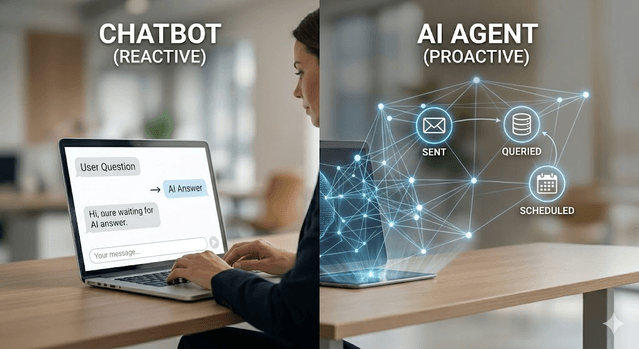
A standard chatbot is input-output. You prompt, it produces text, the conversation is the whole product.
An agent adds three layers. First, it uses tools — searching the web, writing code, querying databases, sending emails, calling APIs. Second, it remembers context across steps, not just within one message. Third, and most important, it plans multi-step workflows and decides what to do next based on intermediate results.
The way I explain it to non-developers: a chatbot is asking an assistant a question and getting an answer. An agent is hiring that assistant to complete a project — they figure out the steps, gather what they need, act, and report back when it is done. When I let a coding agent loose on a refactor, that is exactly what it does.
How agents are being deployed in 2026
Around 79 percent of organizations had adopted some form of agentic AI by 2025, with 96 percent planning to expand. Analysts project 40 percent of enterprise applications will embed agents by the end of 2026, up from under 5 percent a year prior. These are not pilots anymore. The deployments cluster in a few high-impact areas.
Customer service is the most visible. Salesforce's Agentforce handled over 380,000 support interactions and resolved 84 percent without human escalation — an agent reading customer history, identifying the problem, checking policy, and deciding a resolution in real time, not a scripted bot.
Healthcare documentation shows measurable gains. AtlantiCare's AI clinical assistant cut documentation time by 42 percent for test providers, freeing roughly 66 minutes per clinician per day — meaningful when physicians spend up to 70 percent of their time on admin.

Business reporting has some of the most dramatic numbers. One case study cut a reporting process from 15 days to 35 minutes, and cost per report from $2,200 to $9. That does not come from slightly better software — it comes from agents autonomously gathering data, analyzing it, and summarizing across systems that used to need several human teams to coordinate.
Inventory and supply chain is maturing fast too: one large North American retailer cut quarterly inventory losses from $5.4 million to $1.6 million after deploying agents to detect demand patterns and manage stock transfers.
The five levels of agent autonomy
Not all agents are equal. A useful framework maps autonomy to five levels, like self-driving cars.
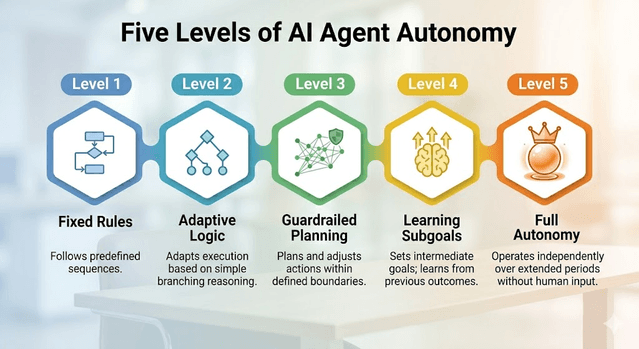
Level 1: fixed rules in a set sequence. Most "agents" today actually live here — sophisticated automation, not real planning.
Level 2: predefined steps, but the order adapts based on logic or reasoning. Handles branching paths.
Level 3: plans, executes, and adjusts within guardrails with minimal oversight. Handles unanticipated exceptions.
Level 4: sets its own subgoals, learns from outcomes, runs over long periods with very little human input.
Most production systems in 2026 sit at Level 1 or 2. Level 3 is emerging in advanced platforms. Level 4 is still mostly research. Worth knowing, because a lot of marketing calls Level 1 automation an "autonomous agent."
Multi-agent orchestration
A clear 2026 trend is moving from single agents to coordinated systems of specialized ones. Instead of one agent doing everything, complex work is split across agents that each do one job well.
A marketing workflow might run: a research agent watches competitors overnight, a content agent drafts copy in the brand voice, a creative agent makes visuals, a reporting agent compiles weekly performance. Each is narrow and reliable; an orchestration layer passes context between them.
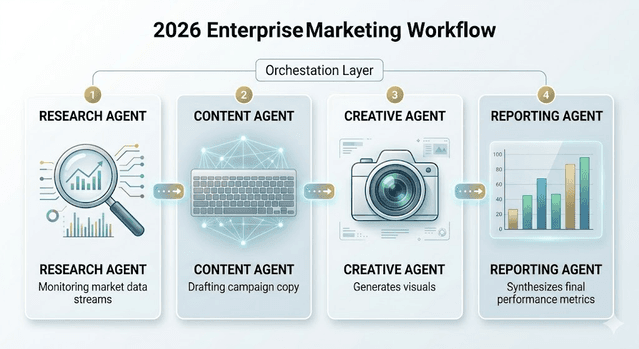
It mirrors how a good team works — defined roles, clean handoffs, a system that accomplishes more than any one member could.
Guardian agents: the governance layer
As organizations deploy more agents, a new category watches them: guardian agents that monitor other agents for compliance issues, safety failures, hallucinations, and scope drift.
Gartner projects guardian agents will capture 10 to 15 percent of the agentic AI market by 2030. Salesforce already built a trust layer into Agentforce that checks for privacy issues, bias, and hallucinations in real time, escalating to humans when confidence drops. It is a genuinely interesting pattern: the answer to governing autonomous AI is partly more agents watching the first layer.

What agents still cannot do well
Knowing the limits matters as much as the capabilities. Agents in 2026 are strong at tasks that are well-defined, repetitive at scale, and verifiable. They struggle with genuine empathy, nuanced social judgment, and decisions where the "right answer" is deeply context-dependent and value-laden.
They also fail on poor inputs. Garbage in, garbage out hits harder with agents, because the agent may take several expensive downstream actions before the error surfaces. Teams that succeed invest heavily in data quality and input validation, not just the models.
Hallucination is still live. A confident-but-wrong intermediate result can propagate across many steps before a human catches it — which is exactly why I read the diff before accepting anything an agent does in my codebase.
Who should start with agents first
Small teams and individuals should begin with repeatable, low-risk workflows: data collection, summarization, report drafts, routing. Do not start with high-stakes customer, legal, financial, or medical decisions where an undetected mistake causes real harm.
If you are not an enterprise
Low-code agent builders now put capabilities that were enterprise-only eighteen months ago in reach of individuals. Zapier, Make, and various AI workflow builders support multi-step agentic flows — you can build an agent that watches a folder for new files, extracts structured data, checks it against a database, and sends a notification, with no code.
For individuals, the practical wins are research automation, email triage, and content research pipelines. For small businesses, inquiry routing, report generation, and inventory monitoring are already saving real time at accessible prices.
The bottom line
AI agents are a genuine architectural shift, not incremental polish. Moving from input-output models to systems that plan, act, and learn changes what software can do and how we interact with it.
The teams seeing the clearest returns start narrow — tasks where success is measurable and errors are recoverable — treat agents as augmentation rather than replacement, and build in governance from the start. If you are wondering whether agents are relevant to your work, do not ask "what is the most impressive thing an agent could theoretically do?" Ask "what is one high-volume, well-defined process where a mistake is cheap and the time saved would be significant?" Start there.
Get Weekly AI + Tech Updates
Receive practical AI tools, workflows, and hand-picked resources in one concise weekly email.
Software Developer & Founder
MCA graduate and Flutter developer (web, Android & iOS), writing from hands-on experience with AI and productivity tools.
I'm Mohd Washid, a 23-year-old software developer. I hold a BCA (2022) and an MCA (2024), and I build cross-platform apps with Flutter for web, Android, and iOS. I started AI Tech Minty to share the AI and productivity tools I actually use in my day-to-day development work — cutting through the hype with practical, hands-on guidance you can act on the same day.